
Moirai: Modeling Biochemistry
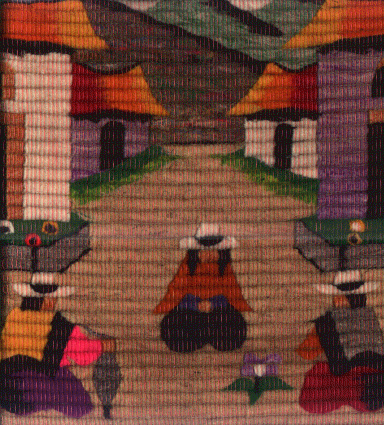
Three cholas (women) preparing to weave. The one on the left holds a heavily laden drop spindle, and is thus analogous to Klotho. The other two are patiently waiting. This is not unreasonable, since usually far more labor is required to spin and process a sufficient quantity of raw wool in preparation for weaving, than in the actual weaving itself. The weaving is Bolivian, of llama, from the neighborhood of La Paz. My thanks to Denise Beusen for bringing this back from her recent astronomical expedition to those parts.
The cellular machine weaves together literally thousands of parts, each with unique structural and functional properties. Both understanding how the cell works and engineering cells with novel properties requires the description and analysis of the components and their interactions. The ultimate aim of Moirai is to build a computational model of intracellular physiology which accurately simulates the effects of experimental manipulation. Apart from their intrinsic interest as databases and automated reasoning systems, we believe such models will stimulate new scientific discoveries and engineering practices. To solve the entailed computational and analytical problems, we have focused our initial efforts on describing the structure and function of simple biochemical systems, beginning with glycolysis.
A sufficiently realistic large-scale model needs to include detailed information on both the structure of the molecular parts and their functions in biochemical reactions. We are developing representations for molecules and reaction biochemistry for use in databases of biochemical function. Our approach is to capture the ``natural language'' of biochemistry in a layered graph grammar , Klotho, which permits interconversion among a family of equivalent representations for compounds, and then operate on these with rules which express chemical and mechanistic aspects of the biochemical reaction (Atropos). The dynamics will eventually be included in Lachesis. An overview of the system is sketched here.
We are using these representations to develop algorithms for several important types of computations. These computations include logical and kinetic simulation of sequential biochemical changes to molecules (``trace the atoms through the pathway''); automated pattern recognition and classification for molecules and biochemical reactions; and fundamental inquiries into the biochemical and dynamic structure of metabolism. The applications of our work may range from understanding fundamental cellular processes, to the prediction of probable metabolic routes of drugs and xenobiotics, to the design of organisms for increased yield of desirable compounds in industrial processes.
.